
Hockey Bets: The Complete Guide to NHL Betting in 2026
 Available in US
There is something uniquely thrilling about betting on hockey. Maybe it is the speed of the game, where a single breakaway can flip a result in seconds. Maybe it is the chaos of a late-game goalie pull, when empty-net goals turn safe leads into nervous sweats. Or maybe it is simply the fact that hockey betting remains one of the last corners of sports wagering where patient bettors can still find genuine value, because the casual crowd has not quite discovered what sharp minds already know.
If you have ever watched an NHL game and thought about putting some skin in the game, you are in the right place. This guide is not a surface-level overview filled with generic advice you could find anywhere. This is a genuine deep dive into how hockey betting actually works, from the fundamental mechanics that every beginner needs to understand, all the way to the strategic nuances that separate recreational bettors from those who consistently turn a profit.
The NHL season offers something that football and basketball simply cannot match: volume combined with inefficiency. With 32 teams playing 82 games each during the regular season alone, you are looking at 1,312 regular season games, plus playoffs, plus international competitions. That is an enormous canvas for finding betting opportunities. And because hockey does not command the same mainstream betting attention as the NFL or NBA, the lines are often softer, the market less efficient, and the edges more accessible to those willing to do the homework.
Throughout this guide, we will explore every major betting market in hockey, from straightforward moneyline wagers to the uniquely hockey-specific puck line. We will dissect prop bets, futures, live betting, and the often-overlooked grand salami. More importantly, we will discuss the strategic thinking behind successful hockey betting: how to evaluate goaltenders, when to exploit schedule spots, and why understanding advanced metrics like Corsi and expected goals can give you a genuine advantage.
What separates this guide from countless others floating around the internet is its practical orientation. We are not here to drown you in theory without application. Every concept discussed comes with real-world context, concrete examples, and actionable frameworks you can implement immediately. The goal is not just to teach you about hockey betting, but to make you a better hockey bettor by the time you finish reading.
A word of caution before we proceed: betting on sports involves risk. No strategy guarantees profit. The house has an edge, and that edge is real. But with knowledge, discipline, and patience, you can minimize that edge, find opportunities where you have an advantage, and enjoy the process regardless of outcomes. The best bettors view this as a long-term endeavor, not a get-rich-quick scheme. If that mindset resonates with you, let us get into it.
Understanding Hockey Betting Fundamentals
Before you place a single dollar on an NHL game, you need to understand the machinery behind the scenes. Hockey betting operates on the same foundational principles as other sports, but with its own quirks and characteristics that reward those who take time to learn them.

At its core, betting on hockey means making predictions about game outcomes and risking money based on odds set by sportsbooks. These odds reflect the probability of each outcome occurring, adjusted to give the house a small edge. Your job as a bettor is to identify situations where you believe the true probability differs from what the odds suggest. When you consistently find these discrepancies and bet accordingly, profits follow.
The legal landscape for hockey betting has transformed dramatically in recent years. Following the Supreme Court decision in 2018 that struck down the federal ban on sports betting, individual states gained the authority to legalize and regulate sports wagering. As of now, more than 30 states have operational sports betting markets, with more joining each year. Canada legalized single-game sports betting in 2021, opening up an enormous market for NHL wagering. If you live in a jurisdiction where sports betting is legal, you have access to dozens of licensed sportsbooks, each competing for your action with bonuses, promotions, and competitive odds.
This competition among sportsbooks benefits bettors directly. When multiple books want your business, they offer sign-up bonuses, odds boosts, and other promotions that effectively put free money in your pocket when used strategically. More importantly, competition creates variance in odds across books, which allows you to shop for the best price on every bet. A five-cent difference in odds might seem trivial on a single bet, but across thousands of wagers over a career, that difference amounts to substantial money.
Reading NHL Odds Like a Pro
Understanding odds is not optional. It is the language of sports betting, and fluency pays dividends. In North America, odds are typically displayed in the American format, using plus and minus signs followed by numbers. The concept is simpler than it first appears.
A negative number indicates the favorite. If you see the Toronto Maple Leafs listed at -150, this tells you how much you need to wager to win $100. In this case, you would need to bet $150 to profit $100 if Toronto wins. The minus sign and the higher number reflect the market's belief that Toronto is more likely to win.
A positive number indicates the underdog. If the Montreal Canadiens are listed at +130 against Toronto, a $100 bet would return $130 in profit if Montreal pulls off the upset. The plus sign and the number represent the premium you receive for backing the less likely outcome.
These odds can be converted into implied probabilities, which help you assess whether a bet offers value. For favorites, divide the odds by the odds plus 100. A -150 favorite has an implied probability of 60% (150 divided by 250). For underdogs, divide 100 by the odds plus 100. A +130 underdog has an implied probability of 43.5% (100 divided by 230). When your analysis suggests the true probability exceeds the implied probability, you have found a potential value bet.
The difference between what you believe and what the odds suggest is where profit lives. Sportsbooks build in a margin called the vigorish or juice, typically around 4-5% on standard bets, which represents their profit. Shopping lines across multiple sportsbooks can reduce this margin and improve your long-term returns. A game might be -145 at one book and -155 at another. Over hundreds of bets, these differences compound into meaningful money.
Essential NHL Bet Types Every Bettor Must Know
Hockey offers a diverse menu of betting options, each with its own strategic considerations. Understanding when and why to use each bet type is essential for building a well-rounded approach.
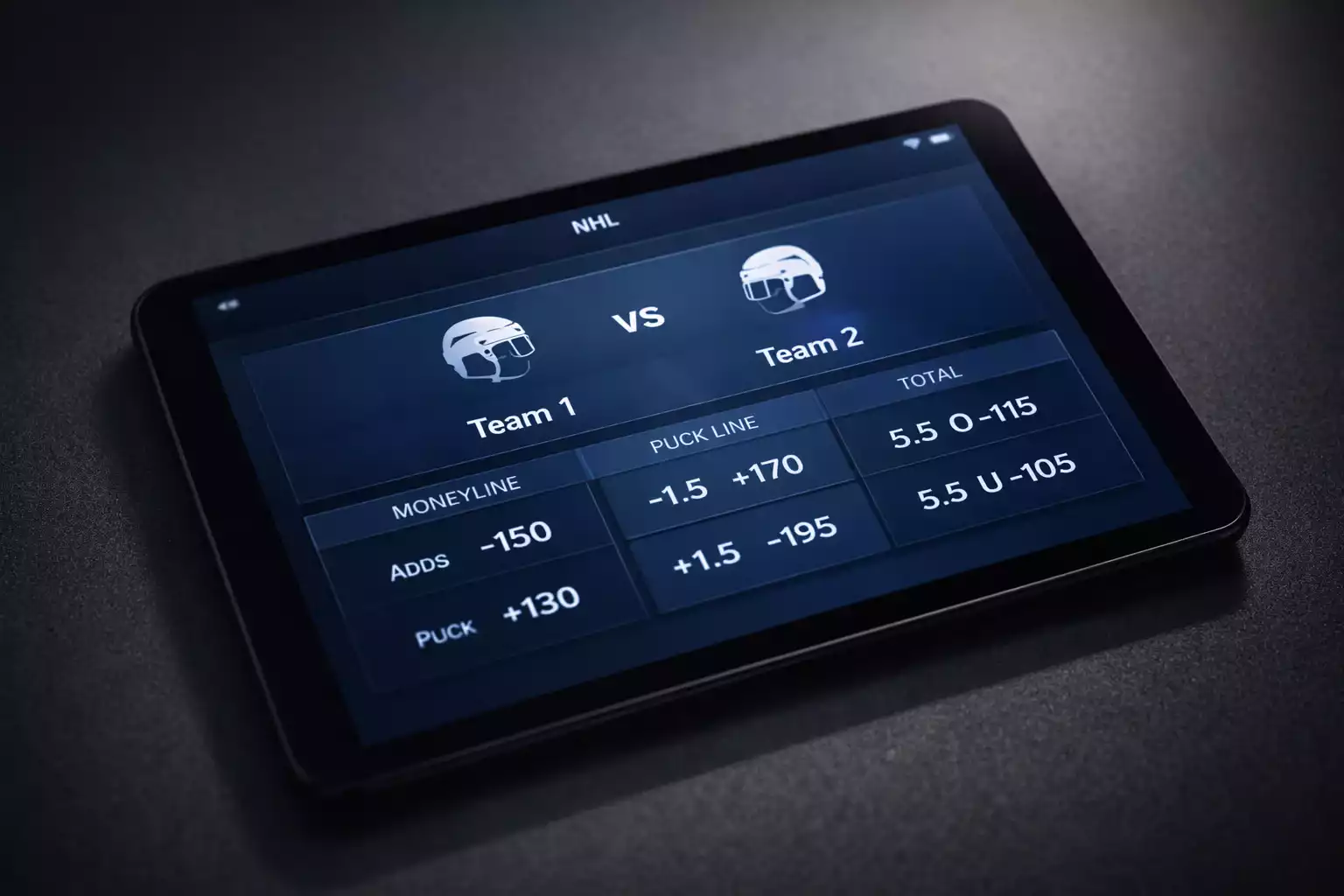
Moneyline Betting
The moneyline is the purest form of hockey betting. You pick which team will win. That is it. No spreads, no totals, just a straight prediction on the outcome.
Moneyline betting suits hockey particularly well because of the sport's inherent unpredictability. Unlike basketball, where a dominant team can easily cover a 10-point spread, hockey games are frequently decided by a single goal. Upsets happen regularly. The worst team in the league can beat the best team on any given night when a hot goaltender steals a game or a lucky bounce changes everything.
This volatility creates opportunities. When the public overreacts to recent results or big names, underdogs can offer tremendous value. A team on a five-game losing streak might be priced at +180 against a division rival, even though their underlying performance metrics suggest the losing streak was largely due to bad luck rather than poor play. Sharp bettors identify these situations and capitalize on inflated odds.
However, moneyline betting on heavy favorites carries risk. Laying -250 to win $100 means you need to win 71.4% of your bets just to break even. One upset wipes out multiple wins. For significant favorites, consider whether the puck line or other markets offer better risk-adjusted returns.
Puck Line Betting
The puck line is hockey's version of the point spread, but it functions quite differently than spreads in football or basketball. The standard puck line is set at 1.5 goals, meaning the favorite must win by two or more goals to cover -1.5, while the underdog covers +1.5 by winning outright or losing by just one goal.
What makes the puck line fascinating is the empty-net dynamic. In close games during the final minutes, the trailing team pulls their goaltender for an extra skater. This desperation move often results in an empty-net goal for the leading team, turning one-goal games into two-goal final margins. This phenomenon means favorites cover -1.5 more often than you might initially expect, particularly in games that remain close until the end.
Betting the favorite at -1.5 typically offers plus-money odds, sometimes around +150 to +180, because covering the spread requires a two-goal victory. But if you identify games where the favorite has a significant talent advantage, strong special teams, and a tendency to protect leads, the plus-money payout can represent excellent value.
Conversely, taking the underdog at +1.5 costs you juice, often around -180 to -220, because you win as long as your team does not lose by multiple goals. This bet functions as insurance against narrow defeats. If you like an underdog to compete but are not confident they will win outright, the puck line lets you back them with a cushion.
Totals Betting
Totals, also known as over/under betting, focus on the combined number of goals scored by both teams rather than which team wins. The sportsbook sets a line, typically between 5.0 and 6.5 for most NHL games, and you bet whether the actual total will exceed or fall short of that number.
Several factors influence game totals. Goaltender matchups are paramount. A game featuring two elite starters like Connor Hellebuyck and Igor Shesterkin tends to produce fewer goals than a matchup of backup netminders. Team pace and style matter as well. Some teams play up-tempo, aggressive hockey that generates scoring chances for both sides, while others prioritize defensive structure and low-event hockey.
Situational context affects totals significantly. Teams playing the second game of a back-to-back often start their backup goaltender and may show fatigue, potentially inflating the total. Division rivals who play each other frequently tend to produce tighter, lower-scoring games because of familiarity with each other's systems. Playoff games almost universally trend toward the under, as defensive intensity increases and referees swallow their whistles.
When betting totals, consider not just whether the game will be high or low scoring, but whether the market has correctly priced the expected output. A total of 6.5 at -110 both ways suggests oddsmakers see roughly equal probability of going over or under. If your analysis strongly indicates one direction, you may have found value.
Prop Bets and Player Props
Proposition bets, or props, focus on specific occurrences within a game rather than the final outcome. They range from straightforward player performance props to exotic game props, offering countless ways to engage with individual matchups.
Player props have exploded in popularity, driven partly by the growth of daily fantasy sports, which trained bettors to think about individual player performance. You can bet on whether Connor McDavid will record over or under 0.5 goals, whether a goaltender will make more or fewer than 28.5 saves, or whether a specific defenseman will register over 2.5 shots on goal.
The key to player prop betting is granular research. League-wide statistics are less useful than matchup-specific analysis. How does the player perform against this specific opponent? What is his recent form? Is he on the top power play unit, which would increase his scoring chances? Does the opposing goaltender struggle with shots from a certain angle or area of the ice?
Anytime goal scorer bets represent a popular player prop market. You bet on whether a specific player will score at least one goal at any point during the game. Odds vary based on the player's scoring ability and the matchup. Elite scorers like Auston Matthews might be priced around +130, while fourth-line grinders could be +800 or longer. Finding value requires understanding ice time, power play deployment, and matchup difficulty.
Game props cover team-based or game-based outcomes beyond the final score. Which team will score first? Will both teams score? What will be the highest-scoring period? These bets add entertainment value and can offer edges when you have strong convictions about game flow. A team known for slow starts might be worth fading in first-team-to-score markets, for example.
Futures and Season-Long Bets
Futures bets are wagers on outcomes that will not be decided until weeks or months in the future. The most popular NHL future is the Stanley Cup champion, but you can also bet on division winners, conference champions, individual award winners like the Hart Trophy or Vezina Trophy, and team season win totals.
The appeal of futures is the potential for significant returns. Betting a team to win the Stanley Cup before the season starts might offer +2000 odds if they are seen as a long shot. If that team lifts the Cup in June, your original stake multiplies twentyfold. Historical data shows that Stanley Cup winners typically open the season somewhere between +500 and +1500, meaning value exists both for true contenders and sleeper picks.
Timing matters with futures. Odds shift constantly based on team performance, injuries, and trades. Betting a team before the season captures better odds if they start hot, but it also means your money is tied up for months. Some bettors prefer to wait until they have seen how a team looks in actual competition before committing to a futures position. Others bet early to lock in value, then hedge later if circumstances change.
Parlay and Same-Game Parlay
A parlay combines multiple bets into a single wager, with all selections needing to win for the bet to pay out. The appeal is amplified returns: a three-team parlay might pay 6-to-1 instead of the roughly 2.6-to-1 you would earn betting each game individually. The catch is that one loss torpedoes the entire parlay.
Same-game parlays, or SGPs, combine multiple bets from a single game. You might parlay the Bruins moneyline with over 5.5 goals and David Pastrnak to score a goal. Sportsbooks offer SGPs with correlated legs, meaning outcomes that tend to happen together. If you expect a high-scoring game, combining the over with anytime scorer bets creates natural correlation that the market may not fully price in.
Parlays should generally represent a small portion of your overall betting volume. The house edge increases with each leg you add, making parlays mathematically unfavorable compared to straight bets. However, they serve a purpose for entertainment and for situations where you have strong conviction on multiple correlated outcomes.
Grand Salami
The grand salami is one of hockey's most unique betting markets. Instead of betting the total for a single game, you bet on the combined total goals scored across all NHL games on a given day. If there are 10 games scheduled, the grand salami might be set at 58.5 total goals across all matchups.
This bet appeals to bettors who have opinions about league-wide scoring trends but do not want to commit to individual game totals. Maybe you believe goaltending around the league has been strong lately and expect a low-scoring night, or perhaps the schedule features mostly offensive teams and you expect fireworks. The grand salami lets you express that view with a single wager.
🏒 Free betting tool
Hockey Odds Analyzer · 2-Way, 3-Way & Puckline
Calculate fair odds for moneyline (including OT) vs. regulation (3-way), and see how the empty-net effect shifts the puckline.
The difference between the 2-way and 3-way market is the detail most hockey bettors overlook — and it's exactly calculable. From the moneyline and total line, we derive how many goals each team averages, and from that comes the complete distribution of outcomes after 60 minutes. The tie probability is boosted slightly because teams with a lead play defense, while trailing teams push hard to equalize: a pure Poisson model underestimates overtime games. What remains is the core insight: a favorite priced at 1.85 including OT should be significantly higher in regulation, and that difference is math, not opinion.
The puckline revolves around one question: how often is a game decided by exactly one goal? That share is high in hockey, which is why a -1.5 bet so often loses while the team appeared dominant. However, there's a factor almost never considered. In the final minutes, the trailing team pulls its goalie, which works two ways. Sometimes the equalizer is scored, but more often the puck slides into the empty net, turning a one-goal lead into a two-goal lead. This shift sits right on the puckline boundary and is exactly why -1.5 hits slightly more often than a pure goal-scoring distribution would predict.
For information only · Please gamble responsibly · 1-800-GAMBLER · Responsible Gambling
Winning Strategies for Hockey Bettors
Knowing the bet types is only the beginning. To consistently profit from hockey betting, you need strategic frameworks that help you find edges where others see only noise.
The Goaltender Factor
No position in professional sports influences game outcomes more than the goaltender in hockey. A hot goalie can steal games his team has no business winning, while a struggling netminder can sink even the most talented roster. Understanding goaltending dynamics is perhaps the single most important strategic element in NHL betting.
Starting goaltender announcements typically come the morning of game day, though some teams confirm their starters the night before. Lines can move significantly when a backup is announced instead of the expected starter. A team might shift from -150 favorites to -120 once their second-string goalie is confirmed. If you can anticipate goalie decisions before the market adjusts, you gain a meaningful edge.
Tracking goalie rotations requires attention to team patterns. Most NHL teams play their starters 50-60 games per season, leaving 25-30 starts for backups. Back-to-back games almost always mean a goalie change. Teams rarely start the same goalie in both games of a back-to-back unless the backup is injured or hopelessly incompetent. Knowing these patterns lets you predict starts and position yourself before announcements.
Key goaltender statistics to monitor include save percentage, goals against average, quality start percentage, and advanced metrics like goals saved above expected. Save percentage tells you what proportion of shots a goalie stops. Goals against average indicates how many goals a goalie allows per 60 minutes. Quality start percentage measures how often a goalie gives his team a chance to win. Goals saved above expected compares actual performance to expected performance based on shot quality, revealing whether a goalie is outperforming or underperforming his competition.
Recent form matters more than season-long numbers. A goaltender who posted a .915 save percentage through November but has been at .880 over his last five starts is likely struggling with something, whether mechanical, mental, or health-related. Conversely, a goalie whose season numbers look modest but who has stopped 95% of shots in his last three games might be finding his groove.
Schedule and Situational Analysis
The NHL schedule is demanding. Teams play 82 games over roughly 180 days, with frequent travel, back-to-back games, and stretches of four games in six nights. These scheduling factors create situations where one team holds a significant rest or travel advantage over their opponent.
Back-to-back scenarios are the most exploitable scheduling spot. Teams playing the second game of a back-to-back are tired, typically starting their backup goaltender, and often traveling between cities. Historical data shows that teams on the second leg of back-to-backs win approximately 45% of their games, a notable disadvantage. If the opponent is rested and at home with their starter between the pipes, the rest edge compounds.
Long road trips present similar challenges. A team finishing a five-game, ten-day road trip through Western Canada before flying across the country to play in Florida is fighting travel fatigue, time zone adjustments, and the accumulated wear of being away from home. Fading these teams, especially against well-rested home opponents, has historically been profitable.
Time zone travel deserves particular attention. A West Coast team flying east for a 7 PM local start is playing at what feels like 4 PM to their bodies. This affects alertness, particularly early in games. Some bettors focus on first-period results for teams dealing with significant time zone transitions.
Advanced Statistics for Betting
Modern hockey analytics have revolutionized how we evaluate team and player performance. While casual fans focus on goals and wins, sharp bettors dig into underlying metrics that better predict future outcomes.
Corsi measures shot attempts, including shots on goal, missed shots, and blocked shots. A team with a Corsi For percentage of 55% is generating more shot attempts than their opponent, suggesting they are controlling play even if the scoreboard does not reflect it. Teams that consistently outshoot opponents tend to see their results improve over time as variance normalizes.
Expected goals, or xG, assigns a value to each shot based on factors like distance, angle, shot type, and whether it came on a rush or rebound. A team might generate 30 shots, but if most came from low-danger areas near the blue line, their expected goal total might be only 2.1. Another team with 20 shots, but mostly from the slot and crease, might have an xG of 2.8. Comparing actual goals to expected goals reveals whether a team is running hot, cold, or performing as expected.
Power play and penalty kill efficiency directly impact outcomes. Teams with strong power play units convert around 22-25% of their opportunities, while elite penalty kill teams hold opponents below 77-78%. Special teams can swing games, particularly in matchups where one team takes significantly more penalties than the other. Identifying teams with hidden special teams edges can uncover value in totals and moneylines.
Line Movement and Sharp Action
Betting lines move for reasons. Understanding why can help you determine whether to bet now, wait, or stay away entirely.
Sharp money refers to wagers from professional or highly skilled bettors. When sharp action hits a sportsbook, the line moves quickly to limit the book's exposure. If a line moves from -130 to -145 without any obvious news, sharp bettors likely backed the favorite. This reverse line movement, where the line moves opposite to public betting percentages, often signals sharp opinion.
Public money tends to come in later, closer to game time, and often backs favorites and overs. When you see heavy public action on one side but the line moving the other direction, respect the line movement. The sportsbook is telling you something about where the informed money is landing.
Following line movement blindly is not a strategy, but incorporating it into your analysis adds context. If your handicapping already leans toward a particular side and you see the line moving in your direction, that confirms your position. If the line is moving against you, pause and consider whether you are missing something the market sees.
NHL Live Betting Strategies
Live betting, or in-play wagering, allows you to place bets while games are in progress. Odds update continuously based on the score, time remaining, and game flow. This dynamic environment creates unique opportunities for engaged bettors willing to watch games closely.

How Live NHL Betting Works
When a game begins, live betting markets open and remain available throughout the contest, pausing briefly when significant events occur like goals or penalties. Odds adjust in real time based on scoring, momentum, and remaining game time. A team that falls behind 2-0 in the first period sees their moneyline odds lengthen significantly, potentially offering value if you believe they can mount a comeback.
Live betting requires quick thinking and strong knowledge of the teams involved. You cannot spend twenty minutes handicapping a decision when the line will move in seconds. Successful live bettors develop mental frameworks that allow them to assess situations rapidly: how much time remains, which goalie is in net, which team has momentum, and what the score means for game strategy.
Momentum-Based Betting
Hockey is a momentum sport. A team that dominates puck possession, generates quality chances, and pins their opponent in the defensive zone often scores eventually, even if they trail early. Recognizing these momentum patterns during live play lets you bet on teams before the scoreboard reflects their dominance.
Shot attempt data, often available on live feeds, provides objective evidence of momentum. If one team has a 15-5 shot attempt advantage through half a period but trails 1-0 because their opponent scored on their only quality chance, the trailing team might offer value on live moneylines. The score says they are losing; the underlying play says they are the better team tonight.
Conversely, some leads are more secure than others. A team up 2-0 but being outshot 18-8 is living dangerously. Their goaltender is stealing the game, and regression could arrive at any moment. In these situations, the leading team's live odds might not adequately reflect the precariousness of their position.
Power Play Live Betting
Penalties create immediate betting opportunities. When a team goes on the power play, their probability of scoring increases significantly, particularly for elite special teams units. Some sportsbooks offer live betting on whether a goal will be scored during a specific power play, or you can bet the next goal will be scored by the team with the man advantage.
Timing is crucial. Live odds adjust rapidly when penalties are called, so you need to act quickly if you have a strong read on a power play unit. Teams with conversion rates above 25% are genuine threats every time they get a man advantage, while weak power play teams might not deserve significant odds adjustments.
Period Betting and Goalie Pull Situations
Live betting offers period-specific markets, allowing you to bet on first period, second period, or third period outcomes. These markets appeal to bettors with strong opinions about game phases. Maybe you believe a team starts slowly but finishes strong. Maybe travel factors suggest a visitor will struggle in the first period. Period betting lets you express these nuanced views.
First period betting deserves special attention because it often operates differently than full-game betting. Some teams consistently struggle out of the gate, requiring time to find their rhythm. Others come out flying and build early leads. Historical first-period data can reveal persistent patterns that the market fails to fully account for. A team that wins the first period at a 60% rate against an opponent who loses the first period 55% of the time creates an exploitable edge when period lines are priced closer to even.
Late-game situations involving goalie pulls are among the most exciting live betting opportunities. When a team trailing by one goal pulls their goaltender with two minutes remaining, they create a high-variance situation: either they tie the game and force overtime, or the leading team scores into the empty net and extends their lead. Live totals and puck lines become particularly interesting in these moments. If the game is 3-2 and the total was set at 5.5, a goalie pull scenario makes the over more likely with every passing second.
The psychology of live betting differs from pre-game wagering. In live markets, you are reacting to what you see in real time, which can lead to both opportunity and trap. Avoid betting based on recency bias, where a single shift or scoring chance unduly influences your assessment. Instead, maintain perspective on the overall flow of the game and how the current situation compares to your pre-game expectations. The best live bettors are those who prepared thoroughly before the puck dropped and use live betting to capitalize on situations that align with their pre-game analysis.
Managing Your Hockey Betting Bankroll
Long-term profitability requires disciplined money management. Even the sharpest bettors experience losing streaks. How you size your bets and protect your bankroll during difficult stretches determines whether you survive to capitalize when variance swings back in your favor.
Unit Sizing Principles
A unit represents the standard size of your bets, typically 1-2% of your total bankroll. If you have $5,000 set aside for hockey betting, one unit equals $50-100. Betting in consistent unit sizes protects you from catastrophic losses during cold streaks while allowing meaningful profits when you run well.
Resist the urge to increase bet sizes after wins or chase losses with larger wagers. The temptation is understandable but counterproductive. A disciplined flat-betting approach, where every bet is the same size regardless of recent results, removes emotion from the equation and lets your edge play out over time.
Some bettors scale their confidence into their bet sizes, wagering 2-3 units on highest-conviction plays and 0.5-1 unit on standard plays. This approach makes sense if your conviction levels genuinely correlate with your win rates. But be honest with yourself. If your three-unit plays do not actually win more often than your one-unit plays, you are just adding variance without adding edge.
Tracking and Analyzing Results
Serious bettors track every wager in a spreadsheet or tracking app. Recording the date, game, bet type, odds, stake, and outcome allows you to analyze your performance over time. Are you profitable on moneylines but losing on puck lines? Do you perform better betting favorites or underdogs? Does your totals betting show an edge?

Without data, you are guessing about your strengths and weaknesses. With data, you can identify what works, double down on profitable approaches, and eliminate or reduce losing patterns. The best bettors constantly evolve their strategies based on evidence from their own results.
Recognizing Variance
Variance is the natural fluctuation in results that occurs even when you are making good decisions. A bet that has a 55% chance of winning will lose 45% of the time. Over 100 bets, you might go 48-52 or 61-39 due to normal variance, even though your true edge is 55%.
Understanding variance prevents emotional reactions to short-term results. A 10-bet losing streak does not mean your strategy is broken. It might just mean bad luck. Similarly, a 15-bet winning streak does not mean you have become a genius. Stay humble, stick to your process, and let the long term sort out the results.
Responsible Gambling
Betting should enhance your enjoyment of hockey, not create stress or financial hardship. Set a budget you can afford to lose entirely without impacting your life. Never chase losses by betting money you cannot spare. Take breaks when betting feels like a compulsion rather than entertainment.
Resources exist if gambling becomes problematic. The National Council on Problem Gambling offers a helpline and support services. Most legal sportsbooks provide tools to set deposit limits, loss limits, and self-exclusion options. Use these tools proactively if you notice warning signs in your behavior.
Hockey Bets Summary and How to Get Started with NHL Betting
Hockey betting rewards those who combine knowledge, discipline, and patience. The game's unique characteristics, from the outsized importance of goaltending to the chaos of late-game goalie pulls, create opportunities that sharp bettors exploit while the casual public overlooks them.
Start with fundamentals. Understand how odds work, what each bet type offers, and why certain situations favor certain wagers. Build from there, incorporating goaltender analysis, schedule spots, and advanced metrics into your handicapping process. Track your results religiously, learn from your data, and continuously refine your approach.
The NHL season is a marathon, not a sprint. More than 1,300 regular season games give you ample opportunities to find value without forcing action on marginal spots. Wait for the right situations. When your analysis strongly supports a position, bet with confidence. When you are unsure, pass and wait for the next opportunity. The games will keep coming, and so will the opportunities.
One of the most underrated aspects of successful betting is emotional control. You will have losing days, losing weeks, and perhaps even losing months. The temptation to abandon your strategy during these stretches is powerful but counterproductive. Trust your process, review your decisions to ensure you are making sound judgments, and understand that variance is a feature of betting, not a bug. The bettors who survive long enough to see their edge materialize are the ones who profit. Everyone else flames out chasing losses or abandoning profitable strategies at the worst possible time.
Most importantly, remember why you started betting on hockey in the first place. The excitement of watching a game you have action on is unmatched. The satisfaction of a well-reasoned bet paying off is genuinely rewarding. Keep those experiences front and center, bet responsibly, and enjoy the ride. Hockey is the fastest, most chaotic, and most unpredictable of the major North American sports. Embrace that chaos, respect the game, and let the bets enhance what is already one of the most entertaining viewing experiences in sports.
Frequently Asked Questions
How do hockey bets work?
Hockey betting involves wagering on various outcomes of NHL games through licensed sportsbooks. The most common bet types are moneyline, where you pick which team wins the game, puck line, which is a 1.5-goal spread similar to point spreads in other sports, and totals, where you bet whether combined goals will be over or under a set number. Odds are expressed in American format, with negative numbers indicating favorites and positive numbers indicating underdogs. You place bets before games begin or during games through live betting markets. Winning bets pay out based on the odds at the time of placement, and losing bets forfeit your stake to the sportsbook.
What is a puck line in hockey betting?
The puck line is hockey's version of point spread betting, standardized at 1.5 goals. When you bet a favorite at -1.5, that team must win by two or more goals for your bet to win. When you bet an underdog at +1.5, that team can lose by one goal and you still win, or they can win outright. The puck line exists because hockey is a low-scoring sport where most games are decided by one or two goals. Unlike football or basketball spreads that vary by game, the puck line stays fixed at 1.5, with the odds adjusting instead. This makes puck line betting particularly interesting when considering late-game empty-net goal dynamics.
Do shootout goals count for betting?
For moneyline bets, the team that wins the shootout is credited with the victory, and the final score reflects one additional goal for the winning team. However, shootout goals do not count for puck line bets, totals, or player props. If a game ends 2-2 in regulation and overtime, then concludes 3-2 after a shootout, the moneyline winner is the team with three goals, but the total for betting purposes is five goals, not six. Player prop bets for goals, shots, or points only count statistics from regulation and overtime, never the shootout. This distinction matters significantly when games appear headed for overtime, as it affects how late-game betting decisions should be evaluated.
